





We’re all well aware of the affordability issues facing insurance currently. Something needs to change – but what?
The affordability of insurance – and its sustainability as a proposition – has been talked about extensively in recent times. In Australia, we’re accustomed to this conversation. After all, news of natural disasters, and the first-hand impact we’re all seeing are increasingly commonplace.
A report by the Actuaries Institute found that the proportion of ‘affordability stressed’ households (those spending more than four weeks of gross household income on insurance premiums) had risen from 10% in 2022 to 15% in 2024. While this is understandable on a fundamental
level – due to rising costs of building materials, labour and increasing claims – there could well come a time when the current approach to insurance isn’t sustainable much longer.
A spokesperson for the Insurance Council of Australia says, “The insurance protection gap – the shortfall between risks that are insured and risks that are not – is widening in high risk parts of Australia, driven by compounding extreme weather events, urban development and growing asset values in high-risk areas, inflation, and the rising cost of reinsurance.
Global Challenge, Local Impact
It’s not an issue confined to these shores, however. In the US, states including California, Florida and Louisiana – prone to wildfires and hurricanes – are facing their own insurance challenges.
The ICA spokesperson continues, “This challenge extends beyond Australia, with Swiss Re reporting that the global protection gap hit a record high of US$1.8 trillion in 2022.
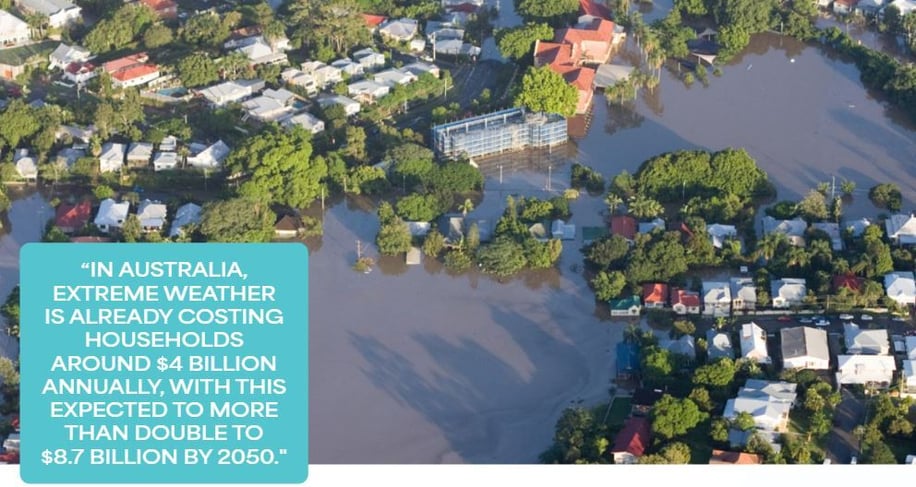
“In Australia, extreme weather is already costing households around $4 billion annually, with this expected to more than double to $8.7 billion by 2050. At the same time, the cost of repairing or rebuilding a home has risen by 29% since the start of the COVID-19 pandemic. These rising costs, combined with more frequent claims and increasing reinsurance premiums, are putting pressure on insurance affordability in high-risk regions.”
Looking at insurance from a business perspective, the warning signs are already emerging.
Dave Bazen, CEO of Asta Group, says:
“The sustainability of insurance is at great risk, given premium rises cannot keep pace with increased weather-related claims costs, which potentially prices many consumers and businesses out of the market, leaving large sectors of the community exposed and even less premium to fund major losses for those remaining in the sector.
“Destabilisation of this balance could collapse the industry unless new strategies are implemented to manage risk exposure in the changing climate.”
Looking for Solutions
Of course, the fact this challenge exists isn’t news to anyone working in the profession. So, what’s the solution?
In NIBA’s pre-budget submission for 2025/26, NIBA CEO Richard Klipin said that insurance can only be one part of the solution for Australian communities.
“A proactive approach to disaster mitigation, focused on long-term investments at both community and household levels, will reduce the impact of natural disasters, enhance resilience, and alleviate the financial pressures that increase insurance premiums.”
NIBA’s submission proposed expanding the Disaster Ready Fund, introducing a national co-funded household mitigation scheme, and creating an advisory committee to address emerging risks.
“Together, these measures represent a critical investment in Australia’s future, helping to strengthen household and community resilience, improve insurance affordability, and ensure communities and businesses can thrive in the face of growing challenges,” Klipin said.
Meanwhile, the ICA is calling for a substantial flood defence fund to be established: “We must accelerate investment in reducing the risk itself. This includes embedding resilience in our National Construction Code, reforming land use planning to ensure development no longer occurs in high-risk areas and investing in infrastructure to reduce risk,” says the ICA spokesperson.
“The Insurance Council is calling for a $30 billion Flood Defence Fund to build new defences, strengthen at-risk homes, support managed relocation, and upgrade existing infrastructure. Removing state insurance taxes is also seen as key to easing cost-of living pressures, given their impact
on premiums.
“Over the longer term, sustained investment in resilience must be paired with long-term action on climate change. The industry is committed to net zero emissions by 2050 and is working with government and regulators to assess climate risk and close the protection gap.
This includes initiatives like the Hazards Insurance Partnership and a Climate Vulnerability Assessment with APRA, alongside research, policy advocacy, and our industry-wide climate roadmap.”
Bazen believes a combination of pragmatic action and risk-sharing funding could hold the key.
“Mitigation of risk primarily needs to focus on moving assets to lower-risk locations, such as moving towns out of floodplains and creating larger buffers between bushland and urban development,” he says.
“Risk-sharing funding strategies should also be considered as a priority, whereby private insurers and government team up to provide sustainable coverage to communities at greatest risk. The New Zealand Earthquake Commission is a good example of government and private insurance risk-sharing, meaning the industry can remain engaged and sustainable in the face of real and
ongoing threats.”
Understanding the Technology Impact – With Caution
Technology will be critically important in building resilience, better understanding risk and limiting damage with early warning and intervention.
We delve into technology in-depth elsewhere in this issue. The ICA spokesperson says: “Technology will be central to these efforts by improving how risk is understood, managed and communicated.
Advanced analytics, AI and machine learning are already transforming risk modelling, helping insurers to more accurately assess and price complex and evolving threats, particularly in high-risk areas. These tools can also support faster claims processing, operational efficiency and more personalised customer experiences, helping to improve affordability and
accessibility of insurance.”
Bazen agrees: “Without the ability to control the weather, the focus must be for new technology to improve resilience in known and anticipated risks,” he says.
“We already have extensive data on the impacts of natural disasters to urban developments and I believe this data is fragmented and underutilised. Detailed analysis of this data will show common areas of weakness in building construction, urban planning and civil infrastructure, all of which can be improved using advanced technologies, such as AI-assisted design.”
We talk in more depth to Amar Roomi, Chief Technology Officer at Blue Zebra and a director of InsurTech Australia in The Insurance E-volution elsewhere in this issue. However, when it comes to using technology to help achieve sustainability in insurance, he has some words of caution.
“Technology can help improve a lot of things in the cost of distribution of products. However, when it comes to risk selection, pricing and underwriting, we need to be careful what we wish for.
“While we absolutely can use technology to help get better on pricing, what if we get too good at it? What does this mean for segments of society that potentially become uninsurable with improved
pricing granularity?
“The core premise of insurance was always about shared risk, and if you’re not sharing risk you’re eliminating segments of currently insured assets in our communities.”
Click to view full magazine